Uncertainty is constant
2025 was a year of relentless economic and political cross currents yet ultimately resolved into a surprisingly profitable period for investors. Risk-on sentiment drove what strategists described as an “everything rally,” and 2025 became the first year since the pandemic where all major asset classes delivered positive returns.
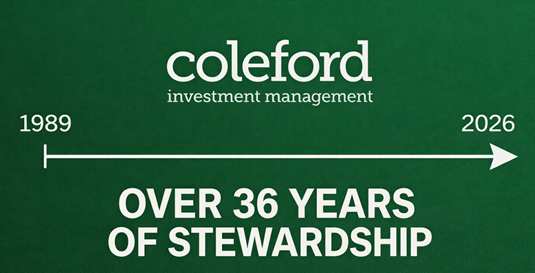
If 2025 proved anything, it is that the world is never short of uncertainty. Throughout Coleford’s 36 years of stewardship of client assets, economic uncertainty has been a constant companion. What does feel different today is the pace and magnitude of events competing for attention. It is difficult to determine whether the world is becoming more volatile in absolute terms, or whether our extraordinarily connected lives simply compress time, amplify headlines, and heighten our perception of instability.
One of the interesting developments in this environment is that markets, particularly equity markets, often appear less reactive to short-term events than one might expect. Not because the events are trivial, but because public markets are increasingly adept at weighing whether an episode is transitory or structural. When the market believes an event is likely to resolve itself, it frequently “looks through” the near-term turbulence and continues pricing businesses on a longer-term earnings and cash-flow trajectory. We discussed this phenomenon in our Q2 2020 commentary when we described a mindset in which investors looked “across the earnings canyon” to temporarily tolerate near-term earnings pressure because they believed the far side of the disruption would feature a strong recovery. The same conceptual framework applies today: where the market has confidence that an issue is time bound, price discovery can be surprisingly calm, even when headlines feel anything but. A recent illustration was the significant U.S. government shutdown that occurred late in 2025. While this event was disruptive and politically consequential, equity markets largely treated it as a short-duration shock – one with limited bearing on the long-run earnings power of durable businesses. In other words, investors appeared to judge that the episode would prove finite, and transitory and they behaved accordingly.
In contrast, President Trump’s April 2 “Liberation Day” announcement – framed as a sweeping expansion of U.S. tariffs on major trading partners – was interpreted by markets as structural: a change that could permanently impair growth, margins, and cross-border commerce. Market repricing was immediate and severe: the S&P 500 suffered a sharp, double‑digit decline in the days that followed as investors recalibrated long‑term profit expectations in the face of an abrupt shift in trade policy. Over time, however, as implementation proved more fluid, with tariff delays, partial suspensions and roll backs, the market’s interpretation evolved. What initially looked like an enduring structural impairment was later seen as a volatile bargaining process, and risk assets rebounded accordingly.
This does not mean risks have disappeared, nor does it imply complacency is warranted. Instead, it reinforces a lesson delivered repeatedly across cycles: markets tend to punish structural impairment far more than short-term disruption. For disciplined investors, the goal is not to predict each headline, but to ensure portfolios are positioned to compound through uncertainty, anchored in business quality, resilience, and valuation discipline.
We also think this is the appropriate context in which to frame one of the most consequential themes of our time: artificial intelligence or AI. The public conversation around AI is loud, crowded, and often speculative. But beneath the noise sits something more durable: a technological shift that is likely to reshape productivity, competition, and capital allocation for years to come. It is in this light that we offer Coleford’s perspective.
AI: structural, meaningful and disruptive
AI can be difficult to define because it spans multiple capabilities and uses. At its core, AI refers to systems that simulate aspects of human intelligence: learning, reasoning, problem-solving, perception, and language. AI not only includes traditional machine learning and natural language processing, but also generative AI, which can produce text, images, and code.
Why does this matter? AI’s economic impact is expected to rival, or potentially surpass, previous transformative technologies such as the internet and mobile computing. Over time, AI is likely to become essential for business competitiveness, efficiency, and innovation across industries. Automation, data-driven decision-making, and personalization will become increasingly standard. In the coming decade, the overall opportunity is often described in multi-trillion-dollar terms. In our view, AI is best understood as structural, not a fad.
A useful way to think about AI is to place it in the lineage of other technologies that fundamentally altered society: canals and railroads, electricity and automobiles, telegraph/telephone and the internet. Transformative technologies share common traits: wide reach, staying power, and the ability to permanently shift behavior and expectations.
History also teaches a hard truth: displacement is the rule. New platforms create winners, but they also create losers, even among prior market-leading incumbents that fail to adapt their core businesses to the new reality.
The investing challenge
The investing challenge is that being right about the technology does not automatically make it easy to be right about the investment outcomes of that technology.
While enthusiasm for AI is understandable, it creates a familiar hazard for investors: expectations can run ahead of fundamentals. In the current environment, valuations in many parts of the AI ecosystem are elevated and often reflect a euphoric view of potential rather than a perspective grounded in a realistic assessment of potential outcomes. Not every investment will generate an acceptable return and scaling AI within a business is capital intensive. Many attractive companies already have “AI upside” priced in, while real-world benefits may take years to materialize. The implication is clear: patience and selectivity matter. Over time, winners are most likely to be those with scale, infrastructure, resources, and genuine adoption, rather than those telling the best stories.
This is another reason why Coleford emphasizes perspective-taking. AI is powerful and promising, but its ultimate trajectory is unknowable today, and investment frenzies often fund both good ideas and dead ends. In that spirit, we anchor ourselves with a classic reminder: “The four most dangerous words in investing are: ‘This time it’s different.’”
Our approach to AI investing
We do not chase speculative expressions of AI. Instead, we prefer platform leaders whose monetization paths are clearer and where downside is mitigated by diversified revenue streams. We believe sustainable AI advantage is derived from: Data Assets, Models & Algorithms, Computing Power, and Distribution & Customers. Within that framework, we view Microsoft and Alphabet as strong across all four dimensions, while Oracle is particularly strong in enterprise data and distribution and is scaling AI through Oracle Cloud Infrastructure and its application ecosystem.
Coleford’s AI exposure is selective and discipline-driven, centered on diversified leaders and hyperscalers, which are firms that are building resources and storage infrastructure and positioning to distribute AI to global customer bases. Hyperscalers dominate AI build-outs because their scale advantages in infrastructure, proprietary models, and global networks are extraordinarily difficult to replicate.
Accordingly, we approach AI investing as we have with other transformative technologies over the past three decades: by emphasizing resilience and capital preservation while ensuring portfolios are positioned for enduring change.
If you’re interested in a deeper discussion of our AI views and portfolio implications, we’d welcome the chance to walk you through our presentation—please reach out to us.
EQUITIES
A notable development in 2025 was the expansion of strong investment performance beyond traditional centres like the U.S., supported by a mix of improving fundamentals, currency benefits, and the global spread of AI-related enthusiasm through international supply chains. AI remained the primary driver in U.S. equity markets in Q4, with investors prioritizing companies poised to benefit from AI-driven earnings and capital expenditures. Certain positions within our model portfolio exceeded general market performance and we see opportunity to realize some gains. The freed-up capital will be strategically reinvested into a wider array of high-quality businesses that offer what we believe to be compelling risk-adjusted return potential over the long term.
FIXED INCOME
When most investors think about monetary policy, they focus on interest rates. But over the past several years, markets have also been shaped by something equally important: liquidity, or how much money is flowing through the financial system. One of the clearest windows into that dynamic is the size of the U.S. Federal Reserve’s balance sheet. When the Fed’s balance sheet is expanding, reserves rise and funding conditions generally ease; when it is contracting, liquidity is being withdrawn and markets tend to become more sensitive to shocks.
Balance‑sheet growth increases system liquidity. After a multi‑year period of liquidity withdrawal, the headwind may be easing, and liquidity conditions may again become a meaningful driver of broader market behaviour.
CLOSING THOUGHTS
As we enter 2026, Coleford’s 37th year of investing for our clients, we remain steadfast in our belief that a conservative, consistent and committed approach delivers the best long-term results.
Our focus on structurally advantaged companies is unchanged and includes platform providers of artificial intelligence as well as leaders in other industries that meet our selection criteria. A fortress-type balance sheet, superior long-term returns on invested capital and a consistent record of shareholder value creation through dividend payments and/or share buybacks are all non-negotiable traits of the companies we select, as are structural advantages such as brand power, efficient scale, unique access to critical supplies and/or steep competitive barriers.
In these uncertain times, and at all times, we believe that diversification and a rigorous, disciplined and patient approach provide the basis for wealth preservation and compounding through economic and market cycles. We look forward to once again proving the value of that steadfast approach in 2026.
There are three constants in life: change, choice and principles.
– Stephen Covey –




2025 Q4 Coleford Quarterly Commentary
Quarterly Commentary
FOURTH QUARTER 2025
Executive Summary
Conservative. Consistent. Committed.
PORTFOLIO MANAGEMENT TEAM
MACRO ENVIRONMENT
Uncertainty is constant
2025 was a year of relentless economic and political cross currents yet ultimately resolved into a surprisingly profitable period for investors. Risk-on sentiment drove what strategists described as an “everything rally,” and 2025 became the first year since the pandemic where all major asset classes delivered positive returns.
If 2025 proved anything, it is that the world is never short of uncertainty. Throughout Coleford’s 36 years of stewardship of client assets, economic uncertainty has been a constant companion. What does feel different today is the pace and magnitude of events competing for attention. It is difficult to determine whether the world is becoming more volatile in absolute terms, or whether our extraordinarily connected lives simply compress time, amplify headlines, and heighten our perception of instability.
One of the interesting developments in this environment is that markets, particularly equity markets, often appear less reactive to short-term events than one might expect. Not because the events are trivial, but because public markets are increasingly adept at weighing whether an episode is transitory or structural. When the market believes an event is likely to resolve itself, it frequently “looks through” the near-term turbulence and continues pricing businesses on a longer-term earnings and cash-flow trajectory. We discussed this phenomenon in our Q2 2020 commentary when we described a mindset in which investors looked “across the earnings canyon” to temporarily tolerate near-term earnings pressure because they believed the far side of the disruption would feature a strong recovery. The same conceptual framework applies today: where the market has confidence that an issue is time bound, price discovery can be surprisingly calm, even when headlines feel anything but. A recent illustration was the significant U.S. government shutdown that occurred late in 2025. While this event was disruptive and politically consequential, equity markets largely treated it as a short-duration shock – one with limited bearing on the long-run earnings power of durable businesses. In other words, investors appeared to judge that the episode would prove finite, and transitory and they behaved accordingly.
In contrast, President Trump’s April 2 “Liberation Day” announcement – framed as a sweeping expansion of U.S. tariffs on major trading partners – was interpreted by markets as structural: a change that could permanently impair growth, margins, and cross-border commerce. Market repricing was immediate and severe: the S&P 500 suffered a sharp, double‑digit decline in the days that followed as investors recalibrated long‑term profit expectations in the face of an abrupt shift in trade policy. Over time, however, as implementation proved more fluid, with tariff delays, partial suspensions and roll backs, the market’s interpretation evolved. What initially looked like an enduring structural impairment was later seen as a volatile bargaining process, and risk assets rebounded accordingly.
This does not mean risks have disappeared, nor does it imply complacency is warranted. Instead, it reinforces a lesson delivered repeatedly across cycles: markets tend to punish structural impairment far more than short-term disruption. For disciplined investors, the goal is not to predict each headline, but to ensure portfolios are positioned to compound through uncertainty, anchored in business quality, resilience, and valuation discipline.
We also think this is the appropriate context in which to frame one of the most consequential themes of our time: artificial intelligence or AI. The public conversation around AI is loud, crowded, and often speculative. But beneath the noise sits something more durable: a technological shift that is likely to reshape productivity, competition, and capital allocation for years to come. It is in this light that we offer Coleford’s perspective.
AI: structural, meaningful and disruptive
AI can be difficult to define because it spans multiple capabilities and uses. At its core, AI refers to systems that simulate aspects of human intelligence: learning, reasoning, problem-solving, perception, and language. AI not only includes traditional machine learning and natural language processing, but also generative AI, which can produce text, images, and code.
Why does this matter? AI’s economic impact is expected to rival, or potentially surpass, previous transformative technologies such as the internet and mobile computing. Over time, AI is likely to become essential for business competitiveness, efficiency, and innovation across industries. Automation, data-driven decision-making, and personalization will become increasingly standard. In the coming decade, the overall opportunity is often described in multi-trillion-dollar terms. In our view, AI is best understood as structural, not a fad.
A useful way to think about AI is to place it in the lineage of other technologies that fundamentally altered society: canals and railroads, electricity and automobiles, telegraph/telephone and the internet. Transformative technologies share common traits: wide reach, staying power, and the ability to permanently shift behavior and expectations.
History also teaches a hard truth: displacement is the rule. New platforms create winners, but they also create losers, even among prior market-leading incumbents that fail to adapt their core businesses to the new reality.
The investing challenge
The investing challenge is that being right about the technology does not automatically make it easy to be right about the investment outcomes of that technology.
While enthusiasm for AI is understandable, it creates a familiar hazard for investors: expectations can run ahead of fundamentals. In the current environment, valuations in many parts of the AI ecosystem are elevated and often reflect a euphoric view of potential rather than a perspective grounded in a realistic assessment of potential outcomes. Not every investment will generate an acceptable return and scaling AI within a business is capital intensive. Many attractive companies already have “AI upside” priced in, while real-world benefits may take years to materialize. The implication is clear: patience and selectivity matter. Over time, winners are most likely to be those with scale, infrastructure, resources, and genuine adoption, rather than those telling the best stories.
This is another reason why Coleford emphasizes perspective-taking. AI is powerful and promising, but its ultimate trajectory is unknowable today, and investment frenzies often fund both good ideas and dead ends. In that spirit, we anchor ourselves with a classic reminder: “The four most dangerous words in investing are: ‘This time it’s different.’”
Our approach to AI investing
We do not chase speculative expressions of AI. Instead, we prefer platform leaders whose monetization paths are clearer and where downside is mitigated by diversified revenue streams. We believe sustainable AI advantage is derived from: Data Assets, Models & Algorithms, Computing Power, and Distribution & Customers. Within that framework, we view Microsoft and Alphabet as strong across all four dimensions, while Oracle is particularly strong in enterprise data and distribution and is scaling AI through Oracle Cloud Infrastructure and its application ecosystem.
Coleford’s AI exposure is selective and discipline-driven, centered on diversified leaders and hyperscalers, which are firms that are building resources and storage infrastructure and positioning to distribute AI to global customer bases. Hyperscalers dominate AI build-outs because their scale advantages in infrastructure, proprietary models, and global networks are extraordinarily difficult to replicate.
Accordingly, we approach AI investing as we have with other transformative technologies over the past three decades: by emphasizing resilience and capital preservation while ensuring portfolios are positioned for enduring change.
If you’re interested in a deeper discussion of our AI views and portfolio implications, we’d welcome the chance to walk you through our presentation—please reach out to us.
EQUITIES
A notable development in 2025 was the expansion of strong investment performance beyond traditional centres like the U.S., supported by a mix of improving fundamentals, currency benefits, and the global spread of AI-related enthusiasm through international supply chains. AI remained the primary driver in U.S. equity markets in Q4, with investors prioritizing companies poised to benefit from AI-driven earnings and capital expenditures. Certain positions within our model portfolio exceeded general market performance and we see opportunity to realize some gains. The freed-up capital will be strategically reinvested into a wider array of high-quality businesses that offer what we believe to be compelling risk-adjusted return potential over the long term.
FIXED INCOME
When most investors think about monetary policy, they focus on interest rates. But over the past several years, markets have also been shaped by something equally important: liquidity, or how much money is flowing through the financial system. One of the clearest windows into that dynamic is the size of the U.S. Federal Reserve’s balance sheet. When the Fed’s balance sheet is expanding, reserves rise and funding conditions generally ease; when it is contracting, liquidity is being withdrawn and markets tend to become more sensitive to shocks.
Balance‑sheet growth increases system liquidity. After a multi‑year period of liquidity withdrawal, the headwind may be easing, and liquidity conditions may again become a meaningful driver of broader market behaviour.
CLOSING THOUGHTS
As we enter 2026, Coleford’s 37th year of investing for our clients, we remain steadfast in our belief that a conservative, consistent and committed approach delivers the best long-term results.
Our focus on structurally advantaged companies is unchanged and includes platform providers of artificial intelligence as well as leaders in other industries that meet our selection criteria. A fortress-type balance sheet, superior long-term returns on invested capital and a consistent record of shareholder value creation through dividend payments and/or share buybacks are all non-negotiable traits of the companies we select, as are structural advantages such as brand power, efficient scale, unique access to critical supplies and/or steep competitive barriers.
In these uncertain times, and at all times, we believe that diversification and a rigorous, disciplined and patient approach provide the basis for wealth preservation and compounding through economic and market cycles. We look forward to once again proving the value of that steadfast approach in 2026.